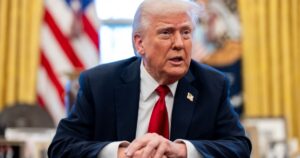

When the two reporters sat down with Trump at the White House in March 2026, seventeen days after the United States went to war with Iran, what they found on the Resolute Desk wasn’t a map of the Middle East. It was printouts of maple trees. Trump, by the authors’ account, seemed entirely preoccupied with buying “good trees,” as the war he had just started seemed the furthest thing from his mind.
That detail, buried inside a book that has triggered a firestorm in Washington, tells you something about the presidency Maggie Haberman and Jonathan Swan spent nearly three years documenting. The two New York Times journalists conducted approximately one thousand interviews over two years to build their account of Trump’s second term. The result, published June 23, 2026, is a portrait of a commander-in-chief who is more emboldened, more impulsive, and more insulated from pushback than at any prior point in his political life – and of a West Wing that has been rebuilt around those instincts rather than against them.
Published just over a year into Trump’s second term, the book lands not as a post-mortem but as a dispatch from the inside of a presidency still in motion and, by the authors’ account, still accelerating. Haberman and Swan appeared on MSNBC’s The Last Word with Lawrence O’Donnell the night before publication for their first live television interview about the book, and what they revealed there went well beyond the anecdotal. The picture they described is one of a government stripped down to an inner circle that most Americans – and most cabinet officials – have no access to.
Who Maggie Haberman and Jonathan Swan Say Is Really Running the Country
Maggie Haberman is a White House correspondent for The New York Times, a New York City native who worked at the New York Post, New York Daily News, and Politico before joining the Times in 2015. She has covered six U.S. presidential elections and was part of the team that won a Pulitzer Prize in 2018 for reporting on Trump’s advisers and their connections to Russia. Jonathan Swan is also a White House correspondent for The New York Times. Together, the two have more sourcing inside the Trump orbit than virtually any other reporters working today – which is what makes their central finding so striking.
Speaking on the O’Donnell broadcast, Swan put the structure of power in plain terms. “Take the war, for example,” he said, referring to Trump’s conflict with Iran. “You have a tiny group of people that are running this country, five or six people and Donald Trump.”
The implications of that number become clearer when you examine who wasn’t in the room. According to the book, “the war-planning group had been kept so tight that the two key officials who would need to manage the largest supply disruption in the history of the global oil market – Treasury Secretary Scott Bessent and Energy Secretary Chris Wright – were still not in the loop, one day before the launch of the war.” The director of national intelligence, Tulsi Gabbard, was also excluded. O’Donnell, reading from the book on air, interjected to confirm: “Tulsi Gabbard not in the room.” Gabbard was the director of national intelligence when Trump declared war on Iran, but has since been replaced by acting Director Bill Pulte.
The closure of the Strait of Hormuz, the narrow waterway through which a fifth of the world’s oil passes, sent global oil costs skyrocketing, and countries around the world grappled with panic buying and supply shortages. That Bessent and Wright – the two officials who would have had to manage those consequences – weren’t consulted in the critical days beforehand is one of the book’s most damaging structural findings.
The names of those who were in the room two days before the first bombs dropped on Iran include Trump, Vice President JD Vance, chief of staff Susie Wiles, CIA Director John Ratcliffe, White House Counsel David Warrington, White House Communications Director Steven Cheung, Press Secretary Karoline Leavitt, Defense Secretary Pete Hegseth, Secretary of State Marco Rubio, and Chairman of the Joint Chiefs of Staff Dan Caine.
A President Operating on Pure Gut Instinct
According to Haberman and Swan, Trump dismissed the possibility that Tehran would close the Strait of Hormuz despite warnings from his top military adviser, Gen. Dan Caine, the chairman of the Joint Chiefs of Staff, about the potential effects on American weaponry and about casualties. The book frames this not as a one-off misjudgment but as the defining mode of the second term.
Haberman told O’Donnell that in Trump’s first term, people at least had a restraining influence – advisers who saw his behavior as dangerous and pushed back. “There’s none of that now,” she said. “They believe there is something almost mystical about him, that he can hear frequencies that maybe they can’t.”
The two journalists write in the book about a change in the way the president has made decisions this time around, claiming he has become more impulsive, more trusting in his own gut, and less concerned about what the polls said about him. The book states that in his second term, unlike his first, Trump “was willing to take breathtaking risks, risks that could throw not only his presidency but the Republican Party and the entire world into chaos and carnage.” More than ever, he was operating on pure gut instinct.
The latest New York Times/Siena poll puts Trump’s approval rating at around 39 percent, on a slow and steady downward spiral since his inauguration. “To the extent he still cared about polling at all, he was seeing far fewer polls than during his first term,” Haberman and Swan wrote. “His advisors knew he was not receptive to being briefed on harsh realities.”
That slide in public standing is examined in depth in this analysis of Trump’s approval ratings, which tracks the data across multiple polling organizations through mid-2026.
The Loyalty Test and the Inner Circle
As readers of the book learn about the dynamic between Trump and the loyalists surrounding him, a genuinely unsettling picture emerges. The president has finally created an administration that works exactly how he wants it to, producing what one reviewer described as a vicious cycle of incompetence and moral corruption. His aides enable him to be the worst version of himself, and in turn he makes them the worst version of themselves.
The new acid test for anyone seeking a place near the center of power was January 6. Anyone with ambitions inside this White House had to demonstrate the right posture toward that day.
The consequence is an absence of dissent that has real policy effects. Haberman and Swan describe Treasury Secretary Scott Bessent urging the president to say publicly he had no intention of firing Federal Reserve Chair Jerome Powell, in order to calm the markets. Deputy Attorney General at the time, Todd Blanche, told Trump there were no grounds to indict New York Attorney General Letitia James, despite Trump’s demand for revenge against her. But moments of dissent were few, and Trump cannot be constrained for long – he did secure the bogus indictment of James, a case that quickly fell apart.
Swan described the shift between the two terms vividly: “He wants to reshape the world. I don’t think he would have gone to war in Iran in the same circumstances in Term 1. I don’t think he would have rolled the dice on what he did in Venezuela. He wouldn’t have started a trade war with the whole world. But he’s in a different mindset, and he’s untethered from all of those domestic political considerations of the first term.”
Behind the Scenes: Superglue, Snacks, and a Document Comparing Trump to Attila the Hun
Haberman and Swan write that in his bedroom, Trump “would frequently leave an array of empty potato chip bags, Starbucks wrappers, and ice cream cartons in the trash, or on the floor,” and that Trump’s hearing has declined – hardly surprising for someone who turned 80 in June – which is why joint press conferences with visiting heads of state are now often held in the smaller Oval Office rather than the larger East Room.
Haberman and Swan also write that Trump superglued gold-colored appliqués to the walls of the Oval Office himself. That piece of reporting, seemingly trivial in isolation, fits a broader pattern the book documents: a president who treats the trappings of power as deeply personal and who has rebuilt the physical space of the presidency to match his aesthetic.
Among the most striking anecdotes in the book is what happened when Haberman and Swan asked Trump about his place in history. Trump produced and proudly shared a two-page document arguing that he was more powerful than Attila the Hun, Genghis Khan, Napoleon, Stalin, Mao, and Hitler – each of whom, the document contended, had only local or regional power, while Trump’s was global. The document was presented as the work of “a historian.” Haberman and Swan report that the actual author was a golf caddy and personal associate of Gary Player.
The Situation Room and the Question of Secret Tapes
Before publication, the book triggered its own pre-release controversy. Haberman and Swan’s book stirred up significant controversy in the weeks before its publication, particularly after news broke that some of their reporting was based on Situation Room meetings that had been secretly recorded and leaked.
When asked directly on air whether they had access to audio recordings from the Situation Room, Swan declined to comment. Haberman later said the two were “not going to discuss sourcing” for the book, but added that they had “worked really hard” to ensure their account was accurate. “To have the only comment we have had from the White House so far be, ‘This is accurate reporting,’ we agree,” she told O’Donnell.
The disturbing accounts of Situation Room meetings sparked concern in the Trump administration that their own people had leaked recordings to the authors. Vice President Vance had already expressed concern about the possibility of someone leaking audio tapes of Situation Room conversations to the reporters.
Swan, for his part, pushed back on the White House’s self-image: “The thing that was really notable about this White House, compared to the first one, is they keep talking about how they’re the most transparent White House in history. It’s a canard. They’re actually incredibly good at keeping secrets.”
Read More: Trump’s Actions in 2026 Are Igniting Anger at Home and Across the World
What This Means for You
The book describes a president willing to take enormous risks that have upended global markets and toppled heads of state – one operating almost entirely on instinct alone, whose deliberations inside the most classified rooms in the world have launched a new war in the Middle East and seen Trump seal the border, surge National Guard troops into cities, and send immigration agents into deadly clashes with protesters.
The central argument of Maggie Haberman and Jonathan Swan’s reporting isn’t really about snacks on the Oval Office floor or gold appliqués fixed with superglue. Those details are real and they matter as texture. But the core finding is structural: the United States is being governed by a circle of five or six people, the cabinet officials constitutionally responsible for managing the biggest consequences of the administration’s decisions are being shut out of the meetings where those decisions are made, and a president who once had guardrails now has none.
The book reveals a second term propelled by a historical irony that Trump himself has come to understand: that the indictments, the convictions, the assassination attempts, and four years of exile made him not weaker but far more powerful, more vengeful, and more willing to gamble than any president in modern history. This is the story of how Trump has used that power, who has tried to stop him, and why nearly all of them have failed.
For readers trying to understand not just the headlines of 2026 but the machinery producing them, Regime Change offers the most detailed inside account available. Whether the country’s democratic institutions prove strong enough to impose the checks that the people around Trump no longer will is the question the book raises but, by design, cannot yet answer.
AI Disclaimer: This article was created with the assistance of AI tools and reviewed by a human editor.