
NASA’s newest Parker Solar Probe imagery looks unreal on a phone screen. Bright arcs and pale streamers slide across the frame. However, many people have shared the clips and asked a practical question: how can a spacecraft get the closest view of the Sun and survive? NASA says the mission matched a record distance on December 13, 2025. It was 3.8 million miles from the solar surface. NASA also says it matched a record speed of 430,000 mph. Those numbers sound like guaranteed destruction, yet the probe kept operating. The answer is not one trick. It is physics, orbit design, and hard engineering. Heat in space behaves differently from heat in air. A heat shield casts a protective shadow. A water cooling loop protects the power system. Autonomous software guards the spacecraft when it cannot talk to Earth. Together, those systems enable NASA Sun footage from the edge of the corona.
Closest view, closest pass, and what “close” means
When headlines say “closest view of the Sun,” they mean the probe observed from its tightest orbit. The spacecraft is not hovering above the visible surface. It remains millions of miles out, inside the Sun’s extended atmosphere called the corona. NASA reported the probe “completed its 26th close approach to the Sun on Dec. 13”. NASA also said it again matched the record distance of 3.8 million miles. The mission team at Johns Hopkins Applied Physics Laboratory built the spacecraft for repeat passes. They did not plan a single close approach. Repeat passes let scientists compare conditions across an active solar cycle. They also clarify what “close” means in practice. Close is still far enough to keep the probe in a stable orbit. It is also far enough to avoid direct contact with the photosphere.
A close pass also includes silence. Near perihelion, the spacecraft cannot stay in continuous contact with Earth. NASA wrote it was “out of contact with Earth and operating autonomously during the close approach.” The spacecraft must keep its shield pointed precisely. The team does not get a full telemetry dump right away. It waits for a simple health check. NASA described the spacecraft “transmitting a beacon tone indicating that its systems were operating normally.” Only later does the spacecraft send detailed telemetry. Science data downlinks can begin weeks later. This is why a dramatic clip can appear long after it was captured. The delay is also why scientists call each close pass an encounter.
Heat versus temperature, and why the corona does not cook like air
To understand survival near the Sun, separate temperature from heat. The corona can reach temperatures of several million degrees, yet it is extremely thin. NASA says, “Counterintuitively, high temperatures do not always translate to actually heating another object.” Temperature tracks particle motion. Heat is energy transferred into the spacecraft. If there are few particles, collisions are rarer. That means less direct heating from contact. NASA compares a hot oven to boiling water to illustrate this. A thin gas can deliver less heat than a denser fluid. NASA also notes that space is mostly empty, with very few particles. So the probe interacts with fewer hot particles than people imagine. However, sunlight still delivers powerful radiation energy.
Radiation is the main threat, and vacuum changes the rules. In space, there is no air for convective cooling. NASA’s thermal control guidance says, “In a vacuum, heat is transferred only by radiation and conduction, with no convection.” Engineers must limit absorbed sunlight and limit internal heat flow. Reflective coatings reduce absorbed energy. Insulation slows conduction into sensitive electronics. Radiators dump heat as infrared light. NASA explains that the heat shield surface heats to about 2,500°F. That is far below the corona’s temperature. It reflects the heat flux reaching the hardware. So survival is about heat transfer, not temperature headlines. The design keeps the spacecraft’s core at workable temperatures.
The heat shield as an engineered shadow
The Thermal Protection System, or TPS, is the mission’s front line. It sits between the spacecraft and the Sun like a portable eclipse. NASA says the shield “will safeguard everything within its umbra, the shadow it casts on the spacecraft.” That shadow is the safe zone. The body, avionics, and most instruments remain inside it. At closest approach, the Sun-facing surface gets extremely hot. NASA reports a striking contrast. It says, “the spacecraft and its instruments will be kept at a relatively comfortable temperature of about 85 degrees Fahrenheit”. That is possible only if the pointing stays accurate. Pointing is as important as heat resistance at these distances. A small attitude error can expose parts that were never meant to see direct light.
NASA also describes how the shield is built. It is “two panels of superheated carbon-carbon composite sandwiching a lightweight 4.5-inch-thick carbon foam core”. Carbon-carbon maintains strength at high temperatures. The foam core is mostly air, so it slows heat flow and saves mass. NASA adds a white coating on the Sun-facing side to reflect as much energy as possible. Lower absorption reduces the heat load. NASA notes the heat shield is 8 feet across and 4.5 inches thick. Despite its size, it stays lightweight because the core is mostly air. The mounting also reduces heat conduction into the spacecraft structure. A shield that conducts heat too well would warm the payload behind it. This is why attachment points and insulation choices matter.
Orbit design, and why Venus matters more than you think
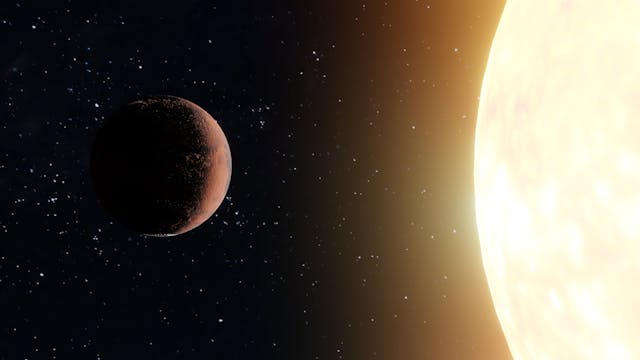
Getting close to the Sun is mainly an orbital challenge. A spacecraft leaving Earth starts with Earth’s sideways orbital speed around the Sun. To fall inward, it must shed that sideways speed. Mission designers solved this with repeated gravity assists at Venus. NASA explains the strategy this way. It says the mission “uses seven Venus gravity assists to rack up more than 900 hours close to the Sun.” Each Venus pass steals orbital energy. Over time, the spacecraft spirals inward without huge fuel costs. Repeated passes also build a richer data set. They let scientists sample fast changes during active solar periods. Orbit design is the reason the mission can gather repeated close-up footage. Designers originally expected a Jupiter assist to be required.
The seventh and final Venus flyby locked in the record-setting orbit. In November 2024, the mission team reported that the spacecraft passed within 240 miles of Venus. That maneuver set up the unprecedented 3.8 million-mile approach on December 24, 2024. Mission design manager Yanping Guo captured the moment. She said, “We’re reaching the crescendo of Parker’s incredible voyage through the inner solar system.” Once the orbit was set, the challenge shifted toward repetition and reliability. Every pass demands precise pointing and stable power. Even the timing of flybys matters, because Venus moves around the Sun. The mission must meet Venus at the right place each time. That choreography is part of the mission’s engineering story.
Power without frying, and the surprisingly ordinary coolant
Power creates a second survival puzzle. Stronger sunlight helps solar panels generate more electricity. It also pushes their temperature toward damaging limits. The probe uses articulated solar arrays that retract into the TPS shadow. NASA notes that at closest approach, “only a small area remains exposed to generate the needed power.” That exposed strip is carefully sized. It provides enough power without presenting a wide target to sunlight. It also reduces how much heated surface can radiate inward. However, even this small strip absorbs intense energy. Active cooling becomes essential at perihelion. The arrays must keep supplying power for instruments and computers.
NASA chose a simple coolant, then engineered it for space. A mission blog explains, “Water flows through mini-channels embedded in the solar arrays to absorb heat.” The same post explains that the water then flows through radiators to release heat into space. NASA adds that the exposed array sections must stay within design limits. The cooling system helps keep them below 302°F. NASA’s “Why Won’t Parker Melt?” article adds that the coolant is about 1 gallon of deionized water. It is pressurized, so it does not boil at high operating temperatures. This loop moves heat from the exposed arrays to radiators with a clear view of space. It also has to avoid freezing during colder phases of the orbit. Without it, the panels would overheat long before perihelion.
Autonomy that keeps one bad angle from ending the mission
Even high-quality thermal hardware can fail due to a single misalignment. The shield must stay pointed toward the Sun within tight limits. Humans cannot pilot it in real time. NASA notes, “It takes light eight minutes to reach Earth.” During close passes, the spacecraft can be out of contact for longer. So autonomy is the only option. NASA states that “the spacecraft is designed to autonomously keep itself safe and on track to the Sun.” Autonomy covers pointing, fault detection, and safe recovery. It lets the mission operate where remote control would arrive too late. It also guards the spacecraft during the most dangerous hours. That includes sudden changes from solar eruptions.
NASA explains the core safety mechanism in plain terms. Sensors sit along the edge of the TPS shadow. If a sensor detects sunlight, it alerts the computer. The spacecraft then corrects its attitude to return to shade. NASA says the software was programmed and extensively tested for these corrections. NASA describes the sensors as small and placed along the shadow edge. They act like a tripwire that detects a bad attitude quickly. Engineers emphasized this requirement even before launch. Johns Hopkins University described the need for autonomy. It called for “an autonomous spacecraft that can take care of itself.” Without autonomy, the probe would not survive repeated close passes. Autonomy is also why controllers accept long communication blackouts.
Why NASA’s Sun footage looks different from telescope images
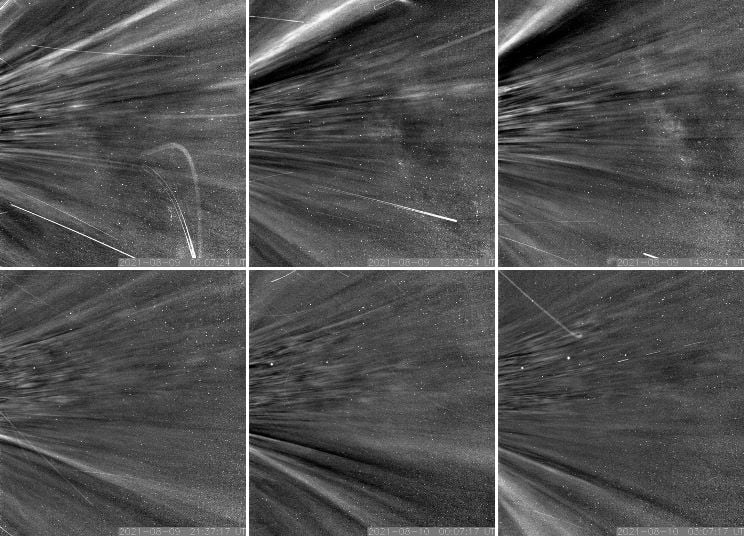
Many viral clips come from WISPR, the Wide-Field Imager for Solar Probe. It is designed to view the corona and the solar wind in scattered light. It is not a telescope aimed at the solar surface. That design makes the imagery look more like weather. In July 2025, NASA released the closest-ever WISPR images and a video sequence. The WISPR instrument scientist said, “In these images, we’re seeing the CMEs basically piling up on top of one another.” That stacking effect shows how eruptions can merge as they travel outward. It also supports later particle measurements during the same encounter. The camera gives context for what sensors measure in the plasma. It can also show the shape of coronal streamers and shock fronts.
Imaging this close requires controlling stray light and background glow. Dust in the inner solar system scatters sunlight, which adds haze. WISPR uses baffles and careful optics to reduce glare. Even so, the view differs from a crisp disk image. It is seeing structures in motion, not the photosphere. For surface detail, Solar Dynamics Observatory observes from a safer orbit and in different wavelengths. NASA also releases versions of WISPR videos that add the Sun’s size to scale. That helps viewers see where the camera is looking. Parker’s value is tying imagery to local measurements taken minutes later. This pairing helps connect visuals to plasma conditions.
What close passes reveal that distance can hide
The mission’s main payoff comes from sampling the corona directly. In December 2021, NASA announced a milestone with one sentence. “For the first time in history, a spacecraft has touched the Sun,” NASA explained. The probe flew through the corona and sampled particles and magnetic fields there. This crossing occurred near the Alfvén critical surface. That boundary marks where the solar wind becomes disconnected from the Sun. NASA also reported that the boundary is not a smooth sphere. It can have spikes and valleys that wrinkle the surface. NASA reported the spacecraft passed into and out of the corona during one flyby. Crossing it helps test ideas about coronal heating and solar wind acceleration. It also proved that the spacecraft can keep returning to this region. Each return improves confidence in the measurements.
As the probe moved closer, it started linking measurements back to solar sources. NASA reported that early passes revealed magnetic switchbacks close to the Sun. Later, NASA said the closest view of the Sun helped identify one place where they originate, on the solar surface. This kind of pinpointing is difficult from far away. At a distance, streams overlap and timing blurs. Close in, the spacecraft samples more local plasma, and it sees structures from within. Close passes also let instruments sample the aftermath of flares and eruption edges. That combination links what WISPR sees to what particle sensors detect. The spacecraft can also cross regions of fast and slow wind near their sources. These are the quiet gains behind the dramatic footage.
Read More: NASA Says Earth Has a Temporary Second Moon — and It’s Sticking Around Until 2083
The big question ends with practical space weather gains
The public question ends with a practical goal on Earth. Space weather can damage satellites and disrupt services. It can also raise radiation exposure for crews and flights. NASA’s December 2025 update links the work to hazards. It lists “astronauts, satellites, air travel, and even power grids on Earth.” To reduce risk, scientists need better physics at the source. Close measurements constrain models of solar wind, eruptions, and energetic particles. That improves prediction tools used by operators. NASA said the probe will remain in this orbit and keep observing. NASA also scheduled science data transmission for January 15, 2026. The mission is under review for steps beyond 2026.
NASA framed the mission’s ambition years before the record passes. Project scientist Nicola Fox described the goal in May 2018. She said, “Parker Solar Probe is going to revolutionize our understanding of the Sun, the only star we can study up close.” The value is repetition. Each close pass adds another data set from a changing environment. Together, they show how the corona feeds the solar wind. They also show how eruptions evolve near their origin. So the survival story is also a design story. Engineers built a shielded, self-protecting spacecraft. Scientists gained a moving laboratory inside the Sun’s atmosphere. That is why the closest view of the Sun is also a scientific tool.
A.I. Disclaimer: This article was created with AI assistance and edited by a human for accuracy and clarity.
Read More: NASA Addresses Claims Earth Will Lose Gravity for Seven Seconds