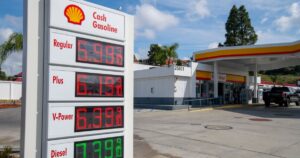

Gas was selling for $2.98 a gallon the day before the U.S. and Israel launched military strikes on Iran. By Memorial Day weekend 2026, that same gallon cost $4.56. Now, a newly rebranded chain called Freedom Fuel is selling it for $3.47 – and the White House is calling that a win.
Freedom Fuel gas stations are cheaper than the current national average. But they’re still 49 cents higher than what drivers paid before the war began. The branding, the price point, and the White House’s enthusiastic promotion of a private company all raise questions that nobody in Washington has fully answered yet.
The company behind Freedom Fuel was registered just two weeks before its public debut. The registered agent it used has a direct tie to Trump. And the petroleum analyst who dug into the numbers says the price point can’t turn a profit without outside help.
What Are Freedom Fuel Gas Stations?
The White House announced the opening of the first Freedom Fuel gas station in Upper Dublin Township, at a former Sunoco station. The first location is a rebranded Sunoco in Dresher, Pennsylvania. A Valero in Bristol, Pennsylvania, and a Shell station in West Berlin, New Jersey, also underwent rebranding under the Freedom Fuel name.
Twenty of the stations are in Pennsylvania, while five are in New Jersey, according to the Freedom Fuel Network’s website. The network covers southeastern Pennsylvania, the Philadelphia suburbs, and parts of South Jersey. Listed locations include stations in Elmwood Park, Bustleton, and Hunting Park, though it was unclear whether every location on the Freedom Fuel website was open.
The White House noted that the $3.47 price tag is a nod to President Trump, who in his second term serves as the nation’s 47th president. The announcement landed on the social platform X on July 7, accompanied by a video of customers at the Dresher station thanking the president for saving them money at the pump.
Who Owns It – and Who’s Paying for the Discount?
The ownership trail raises more questions than it answers. A White House spokesperson told CBS News that the company behind the Freedom Fuel Network is private and that the Trump administration is not involved with the company and is not subsidizing the gas stations, adding that the stations can offer lower prices by reducing their profit margins.
The company itself hasn’t said much. The Freedom Fuel Network did not respond to requests for comment. The White House says it’s not a government program and that the company is not purchasing gasoline at a discount and has received no government funding.
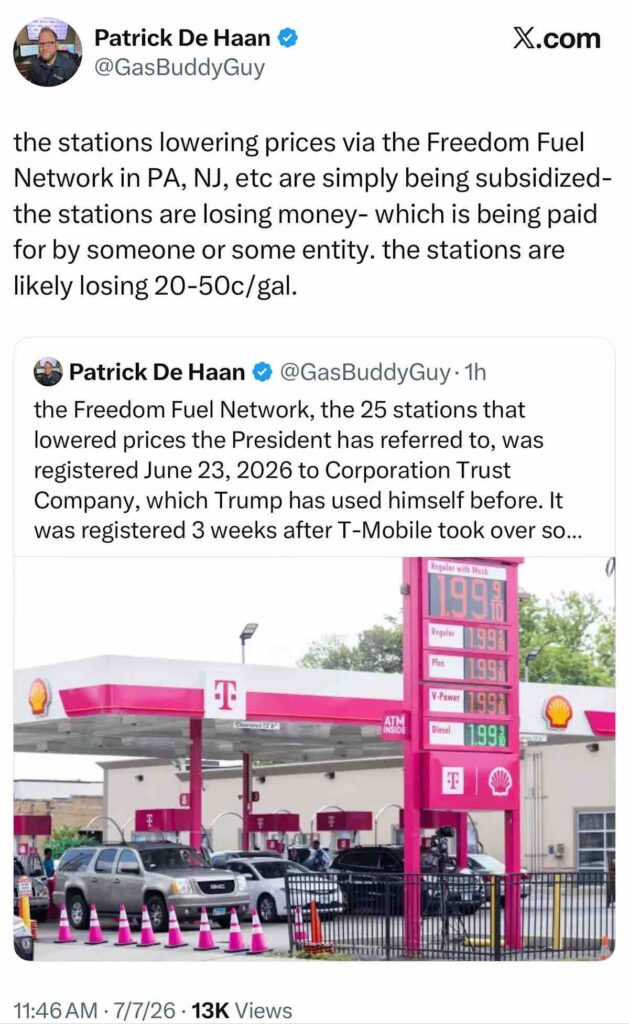
The registration trail adds another layer of questions. Patrick De Haan, head of petroleum analysis at GasBuddy, found that the Freedom Fuel Network was registered June 23, 2026, to Corporation Trust Company – a registered agent that Trump has used himself before. A separate “Freedom Fuel Company, LLC” also filed a trademark application in Delaware on July 1. That LLC’s Wilmington address belongs to Corporation Trust Company and has been used by hundreds of thousands of firms, including numerous Trump corporations, according to The Guardian’s reporting on the registration.
The ownership structure of the company the White House is actively promoting remains unclear to the press, the public, and to analysts who cover the fuel industry for a living.
How Big Is the Actual Discount?
According to AAA’s current gas price data, the average price of a gallon of regular gas nationally was $3.79 per gallon as of July 7, 2026. The Pennsylvania state average was $3.98, and the Philadelphia city average was $3.95. Freedom Fuel’s $3.47 undercuts all of those figures by at least 48 cents.
For drivers in the Philadelphia area, who are paying state averages well above the national figure, the discount is real and noticeable. A nearby Citgo station about five minutes from the Dresher Freedom Fuel location prices regular gas at $3.79 a gallon, while a Gulf station offers it at $3.85 – compared with Freedom Fuel’s $3.47.
For many patrons stopping by, the branding was new and secondary to the savings. One customer, Jessiah Brice, 25, said the station was convenient because it’s near her job. She’d noticed the new branding after the Fourth of July holiday and had no idea what it was about – but she welcomed the cheaper price regardless of the political affiliation. “Gas should be cheaper,” she said.
Freedom Fuel’s $3.47 is below the national average of $3.79, but it’s still higher than the $2.98 average recorded before the U.S. and Israel launched their conflict with Iran at the end of February.
Can This Price Last?
The fuel industry’s answer to that question is blunt. De Haan, whose GasBuddy database tracks prices at stations across the country, ran the numbers and concluded the pricing model was financially untenable. “Stations selling at this price, it’s not sustainable,” De Haan said. “Generally, when losses happen, somebody’s got to pay for it.”
De Haan’s concern isn’t theoretical. Standard retail fuel economics don’t leave room for a 30-plus cent undercut on the national average while covering operating costs at the normal rate. Companies will sometimes offer a discount at a loss to draw new customers into their stores, hoping to recoup the money through additional sales – but Freedom Fuel stations are standalone fueling locations, not convenience-store operations with significant merchandise margins to offset pump losses. De Haan estimated the stations are likely losing 20 to 50 cents per gallon.
De Haan confirmed that many of the stations exist in GasBuddy’s database under names that were “vastly different” from their Freedom Fuel branding. That suggests these are existing independently owned stations that adopted the Freedom Fuel name, rather than a newly built chain – consistent with the rebranding pattern seen in Dresher, Bristol, and West Berlin.
The Gas Price Collapse That Made This Politically Relevant
To understand why $3.47 is even politically meaningful right now, you have to go back to late February 2026. On February 28, 2026, the United States and Israel launched military strikes against Iran in an operation the U.S. Department of War labeled “Operation Epic Fury.” Iran retaliated by blocking shipping traffic through the Strait of Hormuz, a narrow channel of water that had been carrying roughly 25% of the world’s seaborne oil trade and 20% of its liquefied natural gas.
By early April, according to AAA, the national average for a gallon of regular exceeded $4 for the first time since August 2022, hitting $4.08 – ten cents higher than the prior week and $1.08 higher than a month before. The climb didn’t stop there. By Memorial Day weekend on May 21, 2026, the national average hit $4.56, a full $1.38 higher than the same time the previous year, marking the highest gas prices in four years.
Gas prices have since fallen more than 75 cents from that peak, driven by partial easing of the geopolitical standoff and ongoing U.S.-Iran negotiations. The situation remains volatile. Crude oil prices jumped on July 8, 2026, after the Trump administration launched new strikes on Iran, with Trump saying the interim agreement reached with the Iranians in June is “over.”
For Americans already tracking how grocery prices are climbing as the conflict drags on, the pump price volatility is only part of the picture. Fuel costs feed into food production, trucking, and manufacturing – meaning a sustained spike doesn’t stay at the gas station.
What the Midterm Context Means
The timing of the Freedom Fuel launch isn’t incidental. Gas prices above $4 a gallon, household energy costs up by hundreds of dollars, and supply chain disruptions pushing up grocery bills have become the daily reality of a conflict that stretched past 90 days without formal congressional authorization.
A PBS News/NPR/Marist poll conducted in late April found that 63% of Americans blame the president for high gas prices – including about a third of Republicans. That backdrop makes gas prices one of the most politically charged consumer issues heading into November’s midterm elections, and explains why the White House moved quickly to attach the president’s name to a discounted-fuel initiative, even one it officially has no financial stake in.
The launch post from the White House on X called the initiative evidence that “President Trump is leading the charge to lower gas prices this summer.” The framing sidesteps the fact that gas prices are still significantly above where they were when the year began. The military conflict with Iran drove gas prices up from $2.98 per gallon on the day it started to a peak nearly $1.60 higher before beginning their current descent.
Read More: House Votes 215-208 to Limit Trump’s Iran War Powers in Rare Rebuke
What This Means for You
If you’re in the greater Philadelphia area, the Freedom Fuel discount is real and usable right now. The Freedom Fuel Network has published a list of participating locations across New Jersey and Pennsylvania on its website. For drivers averaging 12,000 miles a year in a vehicle that gets 30 miles per gallon, filling up weekly at $3.47 instead of $3.98 saves roughly $100 over three months – not nothing, especially against a backdrop of elevated prices across the board.
The more important question for drivers outside Pennsylvania and New Jersey is what the Freedom Fuel model signals about where gas prices go from here. Gas prices have declined from their wartime peak, but that relief remains unstable. Crude oil jumped again on July 8 after new U.S. strikes on Iran. De Haan of GasBuddy described this as “the most volatile summer at the pump in years,” warning that even after the Strait of Hormuz reopens, it could take a year or more for prices to fully recover.
The practical takeaway: use GasBuddy or AAA’s TripTik travel planner to track local prices week to week, because they’re moving quickly in both directions. If a Freedom Fuel location is near you, $3.47 is a genuine discount compared to the current Pennsylvania and New Jersey averages. Whether the discount lasts – and who is ultimately absorbing the loss to make it happen – are questions the White House and the company behind the network have not yet answered.
Disclaimer: This information is not intended to be a substitute for professional financial advice, investment advice, tax advice, or legal advice, and is provided for informational purposes only. Always seek the guidance of a qualified financial advisor, accountant, or other licensed professional regarding your personal financial situation or investment decisions. Do not make financial, investment, or tax decisions based solely on information presented here. Past performance is not indicative of future results, and all investments carry risk, including the potential loss of principal.
AI Disclaimer: This article was created with the assistance of AI tools and reviewed by a human editor.
Read More: Gas Prices by State: Where You’re Paying the Most (and Least) Right Now