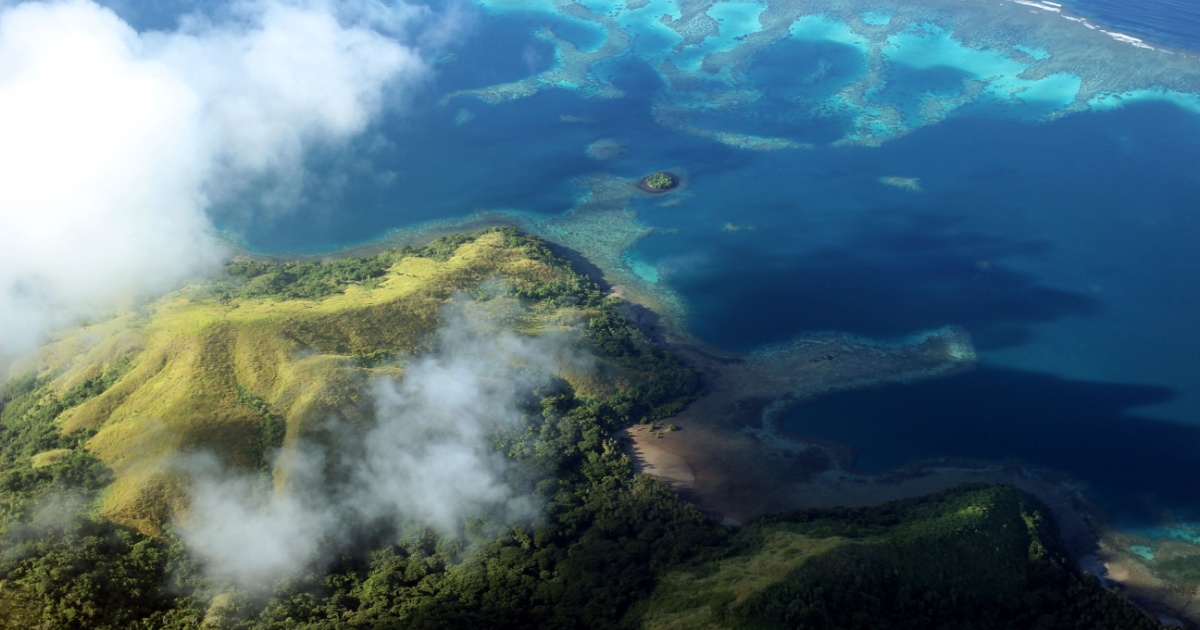

A small, shell-covered island in the Fiji archipelago has become the subject of a striking new archaeological finding, with a research team led by Professor Patrick D. Nunn of the University of the Sunshine Coast in Queensland, Australia, concluding that the site is very likely a human-made structure built by early settlers around 1,200 years ago. The island sits off the coast of Culasawani, a very lightly inhabited stretch of the northern coast of Vanua Levu, Fiji’s second-largest island, and is surrounded by dense mangrove forest. The findings were published in the journal Geoarchaeology in early 2026.
The research team categorized the site as a midden island – a term for land that was built up by people through the gradual accumulation of discarded shells, bones, and everyday debris over time, as opposed to a “muddle” island, which is a natural deposit created by a tsunami or large wave. The word “midden” comes from old Scandinavian and simply means a rubbish heap, though in archaeological terms it refers to an ancient dump site that can reveal an enormous amount about how past communities lived, what they ate, and how they organized themselves.
If the team’s interpretation holds, the Culasawani Shell Island is the first midden island ever recorded in the South Pacific west of Papua New Guinea – a remarkable distinction that positions this Fiji archaeological discovery as one of the more significant findings in Pacific archaeology in recent years.
What the Research Team Found at Culasawani
In January 2017, two of the study’s authors came across the low-lying coastal formation while conducting routine geoarchaeological surveys along the north coast of Vanua Levu. The site did not look particularly striking at first glance. The promontory appeared to be made almost wholly from the remains of edible shellfish in a sandy-clay matrix, and in many places, burrowing mud crabs (Scylla serrata) had brought subsurface materials from depths of 30 to 50 centimeters to the ground surface, exposing what lay beneath. Those crabs were the first clue that something unusual was going on.
Detailed mapping in 2024 confirmed the formation was a discrete island, surrounded by water and mangroves, rising perhaps 20 to 60 centimeters above mean high tide. The team returned twice that year, excavated four test pits, put down 20 narrow hand-auger cores, and sent 10 Anadara shells for radiocarbon dating. Radiocarbon dating is a method scientists use to estimate the age of organic material by measuring the decay of a naturally occurring carbon isotope. It is one of the most reliable tools available for dating ancient sites.
The island covers roughly 3,000 square meters – about the size of 15 standard tennis courts – and rises up to 60 centimeters above the high tide line. Between 70 and 90 percent of its composition is shellfish remains embedded in a sandy-clay matrix. Every shellfish species recovered from the deposit was edible, including Anadara antiquata and Gafrarium tumidum, both common food sources in the region. Radiocarbon dating suggested the midden was likely 1,190 years old, placing its creation in the era of the Lapita peoples – the archaeological culture associated with the first settlers of Fiji – and researchers also found evidence of small fragments of undecorated pottery, suggesting the presence of pre-modern Fijian earthenware.
Who Built Shell Islands in Ancient Fiji?
The people most closely linked to this period of Fijian settlement are known as the Lapita. About 3,200 years ago, Southeast Asian seafarers known as the Lapita pushed east into the tropical islands of the Pacific Ocean, reaching nearly every habitable isle in that corner of the globe, from New Guinea to Fiji and Tonga. In 2016, DNA analysis of four Lapita skeletons found in ancient cemeteries on the islands of Vanuatu and Tonga showed that the Lapita people had descended from inhabitants of Taiwan and the northern Philippines.
Lapita culture villages on islands in the area of Remote Oceania tended not to be located inland, but instead on the beach or on small offshore islets – locations possibly chosen because inland areas were already settled by other peoples. This pattern of coastal living gives particular weight to what researchers found at Culasawani. The most likely explanation, according to Nunn’s team, is that early settlers built stilt-platform homes over the shallow coastal waters at the site, and over generations, discarded shells piled up on the seafloor beneath them.
The Culasawani Shell Island – human-made 1,200 years ago by these early post-Lapita settlers – fits neatly into what archaeologists already know about this community’s relationship with the sea. For more than three millennia, seafood has been an integral food source that enabled populations in the Western Pacific islands to survive, and in some modern communities shellfish still accounts for 15 percent of the food they consume. What the Culasawani find adds is physical proof of just how central shellfish processing was – not merely as a meal, but as an activity significant enough to create an entire island’s worth of material over centuries.
Is Culasawani Shell Island Man-Made?
The short answer, based on current evidence, is yes – almost certainly. But the researchers were careful to rule out the most obvious alternative: that a powerful wave event, such as a tsunami, deposited the shells in a single natural event.
The team initially examined whether a tsunami had deposited the shells in a single event, since the sediment layer showed no obvious internal stratification. They dismissed that possibility after finding the shell-dense sediment confined strictly to the island, with no thinning toward its edges – a pattern that is inconsistent with wave deposition. Waves scatter material outward; a midden grows upward from sustained human activity in one place. The absence of thinning toward the island’s edges was a key detail.
The study noted that “the fact that all shellfish remains are from edible species also suggests that it was not a result of wave deposition,” since a tsunami would sweep up indiscriminate marine material, not just the specific species people ate. Radiocarbon dating of the deposits placed human activity at the site between 420 and 1040 AD. That six-century window points to a community that returned to this spot repeatedly over many generations – not a one-off event.
“The clustering of these ages and the nature of the shellfish remains lead to the preferred interpretation of this shell-dense island as a true ‘midden island’,” the researchers stated. They do not claim certainty – archaeology rarely allows for absolute conclusions – but the weight of evidence points strongly toward human construction.
What Early Settler Research Reveals About Ancient Fiji
This Fiji archaeological discovery matters well beyond the shell-dense island itself. Vanua Levu, despite being the second-largest island in the Fiji Archipelago, has been far less studied by archaeologists than other parts of the country, making this research important and potentially ground-breaking.
Pacific Islander history in Fiji stretches back roughly 3,000 years to the arrival of Lapita seafarers, but the period around 760 CE represents a later wave of occupation – often described as “post-Lapita” – when communities were already well-established and developing more specialized ways of working the land and sea. The early Polynesian settlers of this era were not simply surviving. The team said the island was likely formed by early settlers processing large quantities of shellfish over time, possibly while living on stilt structures above shallow coastal waters. That kind of organized, repeated, specialized activity suggests a community with planning, with purpose, and with an economic life built around the ocean.
The pottery fragments scattered through the shell deposits add another layer to the picture. Small fragments of undecorated pottery were found throughout, suggesting the presence of pre-modern Fijian earthenware. The style of this pottery – plain rather than decorated – fits the post-Lapita period, when the elaborate geometric designs characteristic of early Lapita ceramics had faded from use. Pottery at a shell processing site means people were carrying vessels with them, cooking on site, or storing shellfish meat before taking it elsewhere.
The ancient Fiji human construction at Culasawani also tells us something important about what happened after people stopped using the site. Today, the island sits within a ring of mangrove forest. Researchers believe the mangroves took hold only after the settlement was abandoned, when falling sea levels and sediment from cleared inland areas built up around the river mouth. The forest that now looks so natural is, in fact, a secondary feature – the ecological afterlife of a place that was once alive with human activity.
The article about some Pacific Islanders carrying DNA not linked to any known human ancestor offers fascinating context for how complex and layered the story of Pacific peoples really is.
Why Midden Islands Matter to Archaeologists
Shell middens are among the most information-rich sites in all of archaeology. Midden islands are a gold mine for archaeologists and anthropologists, as they hold clues to sustained human presence, past diets, cultural practices, and living patterns. A single test pit through a well-preserved midden can reveal what species people ate, how their diet shifted over time, what seasons they visited a site, and even clues about the health of the surrounding marine ecosystem.
The Culasawani site is particularly valuable because it is not just a midden deposit on dry land – it is an entire island composed almost entirely of midden material. The authors of the study highlighted that the most important aspect of the discovery is the possibility of having identified an island created “fortuitously by the combined effect of the relative fall of sea level and the vertical accumulation of shells” – an island that literally emerged from the waste of human meals.
Midden islands of this kind have been found in other parts of the world, including Australia and parts of northern Europe, where shell middens have been studied for over a century. But this 1,200-year-old Fiji site is the first of its kind recorded in the South Pacific east of Papua New Guinea. Researchers suspect Culasawani may be an “island of fertility” – a term often applied to middens – because the nutrient-rich deposits promote unique ecosystems of plant and forest growth, which hold invaluable knowledge about the cultures that once discarded their shells there.
Early Settler Research in Fiji: What Happens Next
The 2026 Geoarchaeology paper is a starting point, not a final answer. The team at the University of the Sunshine Coast has outlined several areas of follow-up work they plan to pursue.
One priority will be reconnaissance mapping of the creek mouth and offshore area to see whether other shell-rich, possibly midden, deposits with similar species composition to the Culasawani island exist nearby. If these are located, it could justify reconsidering whether the island might be a wave-deposited formation after all. Good science considers alternative explanations seriously, even after reaching a preferred conclusion.
The researchers also plan to survey local communities to see whether there are any oral memories of large waves – such as tsunamis – impacting this part of the north coast of Vanua Levu. Recent research on volcanic memories on Kadavu Island in Fiji showed that such memories can endure in oral contexts for more than 2,000 years, implying that memories of an extreme-wave event some 1,200 years ago might still be preserved in the community today. This speaks to a broader approach in Pacific archaeology – one that treats indigenous oral history as a legitimate source of evidence alongside radiocarbon dates and excavation data.
The team also wants to identify nearby early settlement sites to build a more complete picture of how communities in this part of Vanua Levu were organized in the first millennium CE. That work could establish whether Culasawani was a dedicated shellfish-processing station serving a larger inland or coastal community, or whether people lived directly at the site itself. The absence of stone tools and animal bones so far points toward a processing station rather than a permanent home base.
Discoveries like this one fit into a growing body of research revealing how much early human communities shaped their environments in ways we are only beginning to recognize. The ancient stone wall found beneath the Baltic Sea, explored in this piece on prehistoric human construction, is another example of how ancient people actively engineered the world around them in ways that outlasted them by thousands of years.
Read More: Scientist Discovered 50,000-Year-Old Lost Colony Off Coast of Australia
What This Means for How We Understand Ancient Pacific Life
The Culasawani Shell Island is a tangible reminder that “ancient” does not mean “simple.” The early Polynesian settlers who built up this island over generations were organized, purposeful, and deeply connected to the marine world around them. They chose specific species. They returned to the same location across centuries. They carried pottery. They very likely lived nearby on platforms above the water, looking out at the same mangrove-fringed coast that researchers visit today. The island they left behind grew up from their discarded meals into a permanent piece of land. That is a remarkable outcome from the ordinary act of eating.
For readers curious about Pacific Islander history, this Fiji archaeological discovery serves as a concrete, physical anchor for what can otherwise feel like abstract deep time. The evidence for Culasawani Shell Island being human-made 1,200 years ago is strong, carefully documented, and cross-checked against natural alternatives. It gives us a date, a behavior, and a place – all of which help reconstruct the lives of people who left no written record. Professor Nunn and his team have given Vanua Levu, long overlooked in Pacific archaeology, a story worth paying attention to. Future excavations will almost certainly add more detail. For now, the shells themselves are speaking.
A.I. Disclaimer: This article was created with AI assistance and edited by a human for accuracy and clarity.
Read More: Ancient 1,200-Year-Old Bread Featuring Christ’s Image Discovered