These States Are Most Likely to See Blackouts This July — Are You Ready?
Every summer, millions of Americans flip on their air conditioning and expect the lights to stay on. Most of the time, they do. But behind that reliable flicker of electricity is a national power grid that experts have been quietly warning about for years. A system running harder, hotter, and thinner than at any point in recent history.
This July, that strain will be felt more acutely in some states than others. Federal grid regulators, independent system operators, and energy analysts have all published assessments pointing to the same set of vulnerable regions. The combination of record demand, aging infrastructure, retiring power plants, and increasingly extreme heat is creating a risk profile that officials are no longer willing to downplay.
This report maps the states most exposed to blackout risk in July 2026, explains the forces driving that risk, and outlines what residents and businesses in those regions should know and do now.
A Quick Overview: Thirteen of 23 North American assessment areas face elevated or high resource adequacy risks over the next five years, according to the North American Electric Reliability Corporation’s 2025 Long-Term Reliability Assessment, released January 29, 2026. For the first time, families and businesses in half the U.S. face a high risk of blackouts. The highest-risk window remains summer, specifically July and August, when heat drives air conditioning demand to peak levels. Nationwide, 74% of business customers experienced some type of power outage in 2025, up from 73% in 2024, according to the J.D. Power 2025 Electric Utility Business Customer Satisfaction Study. The severity of those outages has increased significantly, with the average length of the longest outage for businesses in the Southern region reaching 22 hours.
The pattern is not random. Specific regions face structurally higher risk due to factors including generator retirements outpacing new capacity additions, surging load from data centers and electrification, over-reliance on weather-dependent renewables during peak hours, and limited ability to import power from neighboring grids during simultaneous heat events.
Why the Grid Is Under More Stress Than Ever
The Demand-Supply Gap Is Widening
The North American electric grid faces intensifying reliability risks over the next decade as demand growth driven by data centers and artificial intelligence threatens to outpace resource additions. NERC’s assessment, covering adequacy for 2026 through 2035, projects that summer peak demand could surge by 224 GW, 69% more than the 132 GW projected in the previous assessment.
NERC’s 2025 Summer Reliability Assessment revealed a growing challenge for U.S. grid operators: electricity demand is rising faster than dispatchable resources are being added. NERC projected that peak demand across its U.S. assessment areas would exceed 2024 levels by more than 10 gigawatts, while 7.4 GW of conventional generation, including 2.1 GW of coal capacity, had already retired in advance of the peak heat season.
As John Moura, NERC’s director of reliability assessments and planning analysis, put it: “Simply put, our infrastructure is not being built fast enough to keep up with the rising demand.”
Renewables Are Not Filling the Gap at Peak Hours
A common misconception is that the rapid buildout of solar and wind capacity solves the reliability problem. Solar and battery installations are surging, but NERC cautions that these variable or energy-limited resources do not consistently meet demand when levels remain high during the evening hours.
Those losses are offset by over 40 GW in on-peak capacity gains from new solar, battery, and wind installations, but the regions facing the highest risk are contending with steep load growth that consistently outpaces planned resource additions, particularly as thermal retirements mount and solar-heavy additions introduce variability.
Infrastructure Age and Forced Outages
The U.S. Department of Energy estimates that nearly 70% of transmission lines are over 25 years old, increasing failure risks during peak usage or extreme weather. That aging baseline means unplanned outages during peak demand periods are not exceptional – they are expected. As aging assets near the end of their operational lives, they tend to become less cost-competitive, experience higher forced outage rates, and require overhauls that take them out of service for extended periods, often during summer. As more units retire without timely replacement, on-demand generation capacity declines, contributing to shrinking reserves and greater reliability risks.
The States That May See Blackouts This July
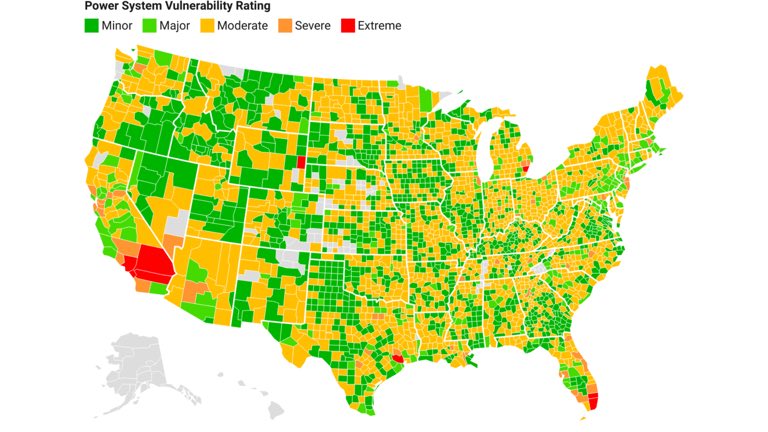
Map of the United States showing county-level results from a nationwide study (2025) by the Urban Resilience AI Lab at Texas A&M University, introducing the first-ever Power System Vulnerability Index (PSVI), which classifies counties based on their risk of frequent and prolonged power outages. Image Credit: Ma et al./Applied Energy
Texas
Texas holds an unusual position in this analysis. During the summer months, peak demand on the Texas grid is typically reached mid-to-late afternoon, with the tightest operating reserves expected during the evening hours as solar generation ramps down before going completely offline, according to ERCOT’s summer weather readiness pages.
The state’s grid operator, ERCOT (the Electric Reliability Council of Texas), runs the grid serving 90% of the state and has added significant new capacity heading into 2025. The addition of more than 9,600 megawatts of capacity to the state’s grid since last summer, coupled with conservative operations, has reduced near-term risk. Of the new capacity added, 5,395 megawatts came from solar, 3,821 megawatts from energy storage, and 253 megawatts from wind power.
However, structural vulnerabilities remain. Integration challenges persist during peak demand periods, especially during the late afternoon when solar generation declines but air conditioning usage remains high. Texas also faces a massive surge in demand for electricity driven by crypto mining facilities, data centers, and population growth. The South Texas Interconnection reliability operating limit continues to present a system constraint which, under specific conditions, could ultimately require ERCOT system operators to direct firm load shedding to maintain grid stability.
Texas also operates its grid in near-total isolation from the rest of the country. That isolation is one of the factors that makes the Texas grid particularly vulnerable to extreme weather, because when supply runs short, Texas cannot easily draw on neighboring states.
The Midwest: MISO Territory
The Midcontinent Independent System Operator (MISO) covers all or parts of 15 states running from the upper Midwest through the Deep South, including Minnesota, Wisconsin, Michigan, Illinois, Indiana, Ohio, Missouri, Arkansas, Louisiana, and Mississippi. NERC’s report identifies MISO as facing elevated risk of energy shortfalls if conditions become extreme, driven by potential underperformance of wind generation during heatwaves.
Over the summer of 2025, MISO issued grid alerts on at least 40 of 69 days between June 11 and August 18, including an Energy Emergency Alert on June 23, according to Power Magazine’s coverage of the 2025 summer season. That real-world track record underlines why analysts continue to flag the region as high-priority heading into 2026.
In the SERC-Central region, which overlaps with parts of the MISO territory, NERC identified a potential shortfall in planned reserves over the 2025 to 2027 period, as demand forecasts increase faster than the transitioning resource mix grows. Coal and natural gas plants are retiring faster than replacement capacity is arriving, and the region’s reliance on imports during heat waves creates a dangerous dependency when neighboring grids are simultaneously stressed.
The Mid-Atlantic States: PJM’s Capacity Crunch
PJM Interconnection is the largest grid operator in the country, coordinating electricity for 13 states and the District of Columbia, including Pennsylvania, New Jersey, Maryland, Virginia, West Virginia, Ohio, Indiana, Illinois, and North Carolina. In December 2025, PJM’s capacity auction fell 5.2% short of reliability requirements for the 2027-2028 delivery year, the first time PJM has experienced such a shortfall, according to energy law firm Jackson Walker.
PJM Interconnection failed to procure enough supply to meet expected future electricity demand in 2027. The capacity auction for the June 2027 through May 2028 delivery year dropped 5.2% below what’s needed to guarantee reliability. The shortfall is driven by slow replacement of retiring power plants and rising demand from electrification and data centers.
For this coming July specifically, PJM is forecasting sufficient generation for typical peak demand and is prepared to call on contracted demand response resources to reduce electricity use during times of high system stress. The National Weather Service forecasts hotter-than-normal conditions in the PJM region’s mid-Atlantic and southern states, as well as West Virginia, Kentucky, and Tennessee. However, PJM’s senior vice president of operations acknowledged that “the outlook resembles last year’s and reflects a new reality – continued load growth driven by data centers that is outpacing the addition of new generation,” adding that “this results in tightening operating reserve margins and greater risk.”
In February 2025, approximately 40 data centers in Virginia’s Loudoun and Fairfax counties, consuming roughly 1,800 MW, enough to power more than one million households, simultaneously transferred to backup power following a high-voltage line failure. The event was the second such incident in Northern Virginia in less than a year. Virginia, in particular, sits at the intersection of PJM’s structural vulnerabilities and the world’s highest concentration of data center load.
New England
New England, covering Maine, Vermont, New Hampshire, Massachusetts, Rhode Island, and Connecticut, operates one of the most constrained grids in the country. ISO New England enters the summer season with a narrow 4% extreme condition margin and expects to rely on operating procedures and imports to meet peak summer demand.
Limited fuel infrastructure and high demand could create significant strain, NERC’s report notes. The region has limited pipeline capacity to deliver natural gas to power plants during periods of high demand, and when heat spikes residential gas use simultaneously with electricity use, generators can face fuel shortages. The risk of supply shortfalls increases in late summer as solar output diminishes earlier in the day, and ISO-NE anticipates an increase of approximately 500 MW in forced outages from its generating fleet compared to the prior summer.
New York also faces heightened attention. An extended heat wave could cripple New York’s grid this summer, according to a recent NYISO analysis highlighted by Utility Dive in April 2026.
The Southwest Power Pool: Central Plains States
The Southwest Power Pool (SPP) covers all or parts of 14 central states, including Kansas, Oklahoma, Nebraska, the Dakotas, and parts of New Mexico and Montana. SPP can meet demand during a typical summer but faces the risk of shortfalls if low wind output coincides with high temperatures and forced outages.
This region depends heavily on wind power, which makes its reliability profile particularly sensitive to weather conditions. During a heat dome, a weather pattern where high pressure traps hot air and suppresses wind, the SPP faces compounding pressure from both soaring demand and underperforming generation simultaneously. Margins in the SPP are tight due to generator retirements and growing load.
California and the West (WECC)
High-risk regions as identified by NERC’s 2025 Long-Term Reliability Assessment include the WECC-Basin area, where planned resources would result in energy shortfalls exceeding adequacy targets.
California faces elevated risk from wildfire disruption and extreme heat, which could challenge grid operations despite ongoing solar buildout. Wildfires can force transmission line shutdowns at the exact moment demand is highest, a combination that has historically triggered rolling blackouts in the state. The state’s growing battery storage capacity has improved the picture in recent years, but the underlying exposure to multi-day heat events and fire-driven outages remains real.
In the Pacific Northwest, precipitation is expected to be lower than average, limiting hydroelectric generation availability. This is a significant concern given how heavily states like Oregon and Washington depend on hydropower as their primary baseload source.
The Southeast: SERC-Central
SERC-Central saw its reserves increase during the prior summer; however, upcoming coal closures will diminish much of that buffer, leaving the sub-region dependent on non-firm imports if higher-than-normal heat coincides with unit outages. The SERC-Central region covers states including Alabama, Georgia, Mississippi, and parts of Tennessee and Kentucky.
The DOE issued a Section 202(c) emergency order on June 24, 2025, due to extreme weather conditions threatening grid reliability in the Duke Energy Carolinas service area, a concrete illustration of how quickly conditions in the Southeast can push operators into emergency territory.
Puerto Rico
While not a state, Puerto Rico deserves explicit mention. The Department of Energy’s initial emergency orders for PREPA, the Puerto Rico Electric Power Authority, followed an island-wide blackout and warnings that Puerto Rico could face up to 135 days of forced load shedding. Emergency orders directed PREPA to dispatch specified fossil generation units “necessary to expand baseload generation for the island and maintain grid reliability.” Those orders have been repeatedly extended well into 2026, signaling that Puerto Rico’s grid remains in a state of chronic instability.
What’s Driving the Crisis Nationwide
Data Centers and AI: The Invisible Load
The explosive growth of artificial intelligence and cloud computing requires massive amounts of reliable energy. New data centers, particularly in Texas, Virginia, and the Midwest, are putting pressure on already stressed power systems.
NERC has flagged voltage-sensitive data center loads as a new and largely unplanned-for class of grid stability risk, and launched a Large Loads Task Force to study their impact. Unlike residential air conditioning, which drops off at night, data centers require electricity around the clock, making them particularly difficult to accommodate within a grid designed for demand that rises and falls with the sun.
The Retirement Wave
Rising peak demand and the planned retirement of 83 GW of fossil fuel and nuclear generation over the next 10 years creates blackout risks for most of the United States, NERC has warned. The problem is not that coal plants are retiring – it’s that the replacement capacity is arriving too slowly. The regions facing the highest risk are contending with steep load growth that consistently outpaces planned resource additions, particularly as thermal retirements mount and solar-heavy additions introduce variability.
The federal government has responded with emergency interventions. The Department of Energy has issued more than 40 Section 202(c) emergency orders since May 2025, a living record tracked by Power Magazine that is updated as new orders are issued and extended. These orders force specific plants to stay online past their retirement dates, a stopgap measure that acknowledges how fragile the supply picture has become.
Extreme Heat: The Trigger
Grids are facing unprecedented strain due to record-high temperatures, which reduce their energy transmission efficiency and spike demand for air conditioning during the summer. The dynamics are self-reinforcing: heat increases demand while simultaneously degrading the performance of transmission equipment, increasing the risk of forced outages at exactly the wrong moment.
Transmission line tripping, which transfers power flow to remaining lines, can lead to line overloads and potentially trigger cascading failures. In the worst-case scenario, insufficient grid inertia against substantial transient imbalances can destabilize the grid, resulting in a catastrophic blackout, according to a 2025 study published in the journal Nature-affiliated PMC.
The Federal Response and Its Limits
On January 16, 2026, the federal government and PJM each offered proposals to address grid capacity shortfalls. The Trump administration released a joint Statement of Principles with all 13 PJM state governors, a rare bipartisan coalition, calling for emergency market reforms. The White House National Energy Dominance Council and all 13 PJM state governors called for PJM to hold an emergency capacity auction by September 2026.
Some DOE orders over the past year have been contentious, particularly December 2025 directives that froze more than 2 GW of coal retirements in Indiana, Washington, and Colorado. The Michigan Attorney General and environmental groups including the Sierra Club and Earthjustice filed the first-ever judicial challenges to DOE’s use of Section 202(c) authority, arguing the orders unlawfully override state regulatory decisions and utility resource plans.
The policy environment, in short, is not resolved. Federal emergency orders can delay retirements, but they cannot build new plants. Transmission expansion, the single most effective long-term fix, faces permitting delays measured in years. Permitting delays and construction timelines are major bottlenecks, a problem NERC has flagged repeatedly in its seasonal assessments.
For residents, the practical implications of this grid stress map are straightforward. If you live in Texas, the Midwest (MISO states), the Mid-Atlantic (PJM states), New England, California, the Pacific Northwest, the Central Plains (SPP states), or the Southeast, your region has been identified by federal regulators as facing meaningful blackout risk under extreme summer conditions. That risk is not hypothetical. It is the product of documented capacity gaps, aging infrastructure, and a weather outlook that consistently trends hotter.
Start with preparation that assumes a multi-day outage is possible, not just a few hours. Keep a battery-powered or hand-crank radio accessible. Maintain at least 72 hours of water and non-perishable food. Know where your nearest public cooling center is, because a prolonged blackout during a July heat wave is a medical emergency, not just an inconvenience. A 2023 study reported that if a multi-day blackout in Phoenix coincided with a heat wave, nearly half the population would require emergency department care for heat stroke or other heat-related illnesses, with researchers estimating 12,800 deaths.
Second, reduce your household demand during peak hours. Energy conservation is a widely used industry tool that can help an electric grid by lowering demand for a specific period of time, which is typically late afternoon into evening in the summer, according to ERCOT. Similar guidance applies across every at-risk region. Every megawatt of demand reduction during a grid stress event directly reduces the probability of a wider outage.
Third, if you have medical equipment, mobility limitations, or other vulnerabilities that make a power outage dangerous, register with your local utility as a “life support” or “vulnerable customer.” Most utilities maintain these registries and prioritize restoration for those households. Do not wait until an emergency to make that call.
The map is drawn. The regions at risk are known. Regulators like NERC have documented the gaps. The question now is whether individuals and communities will prepare before July, not after.
AI Disclaimer: This article was created with the assistance of AI tools and reviewed by a human editor.