Antarctica’s Gold-Spewing Volcano Is Real — And Scientists Still Don’t Know How It Works
Every day, somewhere deep in Antarctica, a volcano dusts the surrounding ice with gold. Not metaphorically – actual gold, in the form of microscopic metallic crystals, drifting on the wind across one of the most remote stretches of land on Earth. The particles are real, they’ve been confirmed in snow and air samples, and they travel far. What scientists still can’t fully explain, more than three decades after the discovery, is exactly how they form.
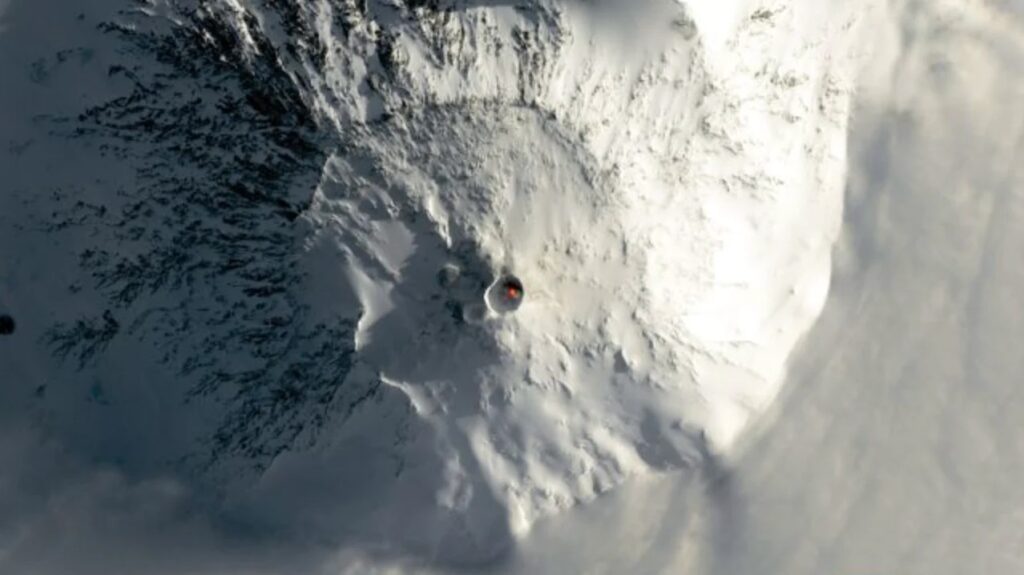
Mount Erebus sits on Ross Island in Antarctica’s Ross Sea, roughly 1,350 kilometers from the Geographic South Pole. It is the world’s southernmost active volcano. At its summit, the volcano has hosted a long-lived lava lake in its inner crater that has been present since at least the early 1970s. The mountain itself is not unusual by volcanic standards – dramatic, remote, perpetually active. What makes it unlike any other volcano on the planet is what rides out with its gas.
Crystalline particulate gold has been found in the plume near the crater, in ambient air up to 1,000 kilometers from the volcano, and in near-surface snow samples. The phenomenon was first formally documented in a 1991 paper in Geophysical Research Letters by researchers including Kimberly Meeker and Philip Kyle. That paper showed that the particles condense from the volcano’s emissions, which include approximately 80 grams of gold vapor daily – an amount that is actually low compared to other volcanoes, but the condensation of that vapor into solid crystalline gold particles was the first ever documented anywhere in the world.
What the Gold Actually Looks Like
The particles are nothing like the chunky flakes or nuggets that gold rush prospectors sifted from riverbeds. Under an electron microscope, the particles appear as intricate, faceted, almost perfectly geometric crystals rather than irregular specks, with some measuring up to about 60 micrometers across. For reference, 60 micrometers is roughly the width of a human hair. These tiny particles of volcanized gold disperse from Erebus up to 1,000 kilometers across Ross Island – and at around 60 microns, the gold flecks are much smaller than the thickness of a human hair.
The crystalline structure is what separates Erebus from other volcanoes. Many volcanoes emit trace amounts of gold in gaseous form, but the gold either stays gaseous or is destroyed during the eruption process. Many volcanoes have gases with gold in them, but they remain gaseous. In Antarctica, when gold-bearing gas makes contact with the frigid air, it solidifies into metallic form – something that doesn’t happen anywhere else in the world. The extreme cold of the Antarctic atmosphere appears to be at least part of the reason why the gold crystallizes rather than dissipating. Nearby McMurdo Station sits only a few meters above sea level but can reach -50°C, and it’s thought that when the bracing Antarctic air meets the scorching surface of Erebus’s lava lake, the conditions for solid gold to materialize are created.
Mount Erebus aerial view. Image Credit: European Union, Copernicus Sentinel-2 imagery
The Lava Lake at the Heart of It
Mount Erebus is a large alkaline open-conduit stratovolcano that hosts a vigorously convecting and persistently degassing lake of anorthoclase phonolite magma. Anorthoclase phonolite is a rare type of volcanic rock – highly evolved, alkali-rich, and unlike the basaltic magma found in most other active volcanoes on Earth. The lava is specifically called anorthoclase phonolite, where anorthoclase is a feldspar mineral and phonolite refers to rocks made of alkali feldspar and nepheline.
Mount Erebus is the only phonolitic volcano on Earth with a persistent summit lava lake. That makes it doubly unusual: unusual for having a permanent lava lake at all, and unusual for the composition of the magma in that lake. The Erebus lava lake is one of only about six persistent lava lakes on Earth, measuring approximately 20 to 30 meters in diameter inside a crater about 100 meters deep. The magmatic temperature inside the lake has been measured at approximately 1,000°C, and studies show this temperature has remained stable for decades.
Large temperature variations do occur at the lake surface, ranging from around 400°C to 500°C, but these fluctuations are not reflected in the mineral compositions of the erupted material – suggesting the deep chemistry of the system is remarkably consistent. The bulk composition and matrix glass of Erebus ejecta has remained uniform for many thousands of years, though eruptive activity varies on shorter timescales.
Philip Kyle, Professor Emeritus of Geochemistry at New Mexico Tech and former director of the Mount Erebus Volcano Observatory, has described the lava lake as a direct window into the volcano’s interior. “Few have scaled the nearly 3,800-meter summit to peer into its churning pool of molten rock,” Science News noted – a lake roiling at roughly 1,000 degrees Celsius. Kyle was a member of the original research team that documented the gold emissions and later proposed one of the leading hypotheses for how the crystals form.
How the Gold Escapes the Magma – And Why Science Still Doesn’t Fully Know
This is where the story gets genuinely unresolved. Gold is present in magma around the world. What’s rare is gold making it to the surface as elemental, crystalline metal rather than staying locked in chemical compounds.
One early hypothesis was that the gold condenses directly from the volcanic gas as it cools rapidly on contact with the Antarctic air. One difficulty with that model is that the gas contains very little gold, and under those conditions the spontaneous formation of beautifully formed crystals in open air is very difficult to explain.
A separate scenario, later proposed by Philip Kyle, suggests that the gold forms more gradually in a crust on the surface of the lava lake itself, before being carried aloft by rising gases. Under this model, the slow, steady circulation of the lava lake – constantly cycling magma up from depth – could allow gold to concentrate at the surface over time, eventually becoming light enough to be lifted into the plume. It’s been more than three decades since the original discovery, however, and researchers still don’t have a definitive answer.
What does seem clear is that something specific to Erebus’s geology, chemistry, or environment enables this phenomenon. Other volcanoes in similar polar or high-altitude settings don’t produce crystalline elemental gold. Erebus is alone in this.
Antarctica’s Volcanic Landscape
Erebus isn’t Antarctica’s only volcano, though it is by far the most studied. There are dozens of volcanoes in Antarctica, the majority in West Antarctica and Marie Byrd Land – a 2017 study identified 138 volcanoes in that part of the continent alone – and while most are dormant, eight or nine are considered active.
Erebus was erupting when it was first sighted in 1841 during the voyage of Captain James Clark Ross, who carried out important magnetic surveys in the Antarctic and discovered the Ross Sea. The mountain is named after the personification of darkness in Greek mythology, a name carried over from one of Ross’s ships. With a summit elevation of 3,792 meters (12,441 feet), Erebus is the second most prominent mountain in Antarctica and the second-highest volcano on the continent, after the dormant Mount Sidley.
The other confirmed active volcano on the continent is Deception Island, an unusual horseshoe-shaped caldera near the Antarctic Peninsula. Deception Island is far more accessible than Mount Erebus and sees regular boat tours. Its most recent major eruptions came in the late 1960s, when three separate eruptions damaged nearby scientific research stations.
Erebus, by contrast, has been under near-continuous scientific observation for decades. The volcano’s proximity to McMurdo Station – the United States’ main Antarctic research base – means it has received more attention than any other Antarctic volcanic system.
For those curious about the broader story of volcanic geology in surprising environments, the Yellowstone supervolcano offers another fascinating case study in how much volcanic systems can surprise even the scientists who study them most closely.
The Gold Nobody Can Collect
Scientists estimate Erebus spews around 80 grams of gold a day, worth around $6,000. Annualized, according to UPI, that adds up to roughly $2.19 million in gold scattered across the Antarctic snow each year. The figure sounds remarkable – and it would be, if any of it were collectible.
The practical obstacles are insurmountable. The particles measure up to 60 micrometers at most – far too small to gather by any conventional means. They drift on Antarctic winds across hundreds of kilometers of some of the most inhospitable terrain on Earth. And even setting logistics aside, collecting them would be illegal: the Antarctic Treaty, signed in 1959 and still governing activity on the continent, prohibits any resource extraction. Even if it were feasible to collect the gold microparticles from the expansive Mount Erebus plain, the haul would be legally off-limits in about two-thirds of the world.
The gold from Erebus exists, in other words, as a geological fact rather than a resource – a daily reminder that the planet’s interior chemistry is still producing surprises in places where almost no one can see them.
What This Means for You
The story of the Antarctica volcano gold isn’t really about treasure. It’s about how much of Earth’s geology remains incompletely understood, even at sites that scientists have studied for half a century. Mount Erebus has been monitored continuously since the early 1970s, and yet the mechanism that produces crystalline gold in its plume still lacks a definitive explanation.
Erebus offers a unique opportunity to investigate magmatic system processes from the mantle source to the surface, and to study the enigmatic structural controls of extensional magmatism and volatile release. The gold is a side effect of those deeper processes – almost an accidental byproduct of a volcanic system that operates differently from anything else on the planet.
The practical takeaway is this: if you follow Earth science news, keep watching Erebus. The volcano is still active, maintaining its persistent phonolite lava lake and producing regular Strombolian explosions as recently as January 2026. The gold is still falling on the ice. And the question of how it forms is still open – the kind of question that, when answered, will likely teach us something useful about how gold ends up in the Earth’s crust in the first place.
AI Disclaimer: This article was created with the assistance of AI tools and reviewed by a human editor.